
Sovereign AI for Asset Management
Sovereign AI keeps asset data on Australian soil. Learn why data sovereignty matters for critical infrastructure, how edge computing enables local AI processing, and what asset owners need to know about deploying AI without cloud dependency.
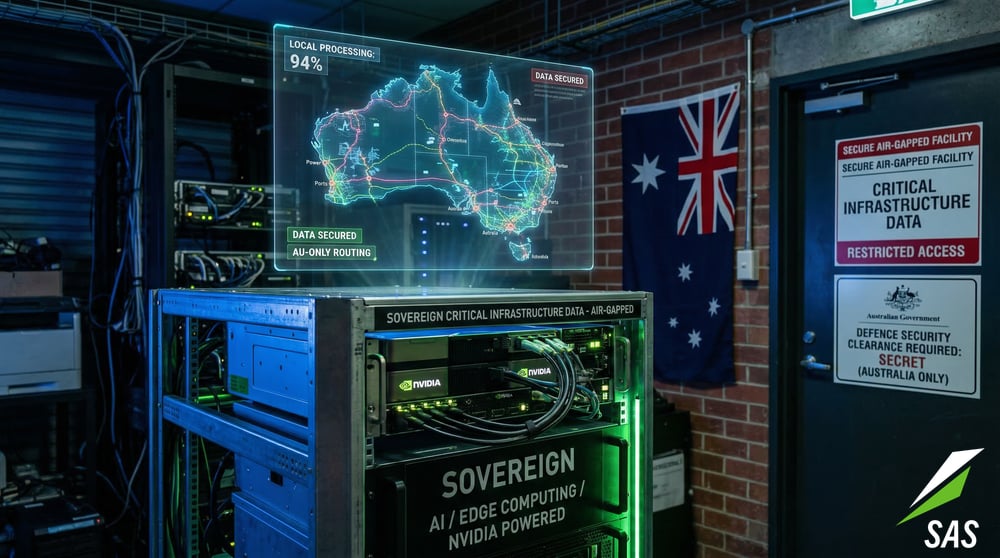
.jpg)
What Is Sovereign AI?
Sovereign AI refers to artificial intelligence systems that are designed, deployed, and operated entirely within a nation's borders, under its legal jurisdiction, and in accordance with its data sovereignty requirements. For asset management, this means AI models that process sensor data, predict failures, and optimise maintenance decisions without sending sensitive operational data to overseas cloud servers.
In Australia, sovereign AI has moved from a niche concern to a strategic imperative. Critical infrastructure operators — from defence installations to mining operations, water utilities to rail networks — are increasingly recognising that the convenience of global cloud AI comes with unacceptable risks around data control, latency, and regulatory compliance.
Why Sovereign AI Matters for Australian Critical Infrastructure
Australia's critical infrastructure landscape is unique. Vast distances, remote operations, and a regulatory environment that increasingly demands data localisation make sovereign AI not just desirable but essential for many asset-intensive organisations.
Defence and National Security
The Australian Department of Defence has made sovereign capability a cornerstone of its technology strategy. Asset condition data from defence platforms — submarines, aircraft, vehicles, and fixed infrastructure — is classified or sensitive by nature. Sending this data to overseas cloud providers for AI processing is simply not an option. Sovereign AI enables defence organisations to leverage machine learning for predictive maintenance while maintaining complete control over their data.
Mining and Resources
Australia's mining sector operates some of the most capital-intensive assets on earth. Haul trucks, draglines, processing plants, and conveyor systems generate terabytes of sensor data daily. Many mine sites are in remote locations with limited or no reliable internet connectivity. Sovereign AI deployed at the edge allows these operations to run predictive maintenance models locally, without dependence on cloud connectivity.
Utilities and Water
Water treatment plants, pumping stations, and distribution networks are classified as critical infrastructure under the Security of Critical Infrastructure Act 2018 (SOCI Act). The Act imposes positive security obligations on operators, including requirements around data handling and system security. Sovereign AI solutions help utilities meet these obligations while still benefiting from advanced analytics.
Data Sovereignty Regulations and Requirements
Several regulatory frameworks drive the need for sovereign AI in Australian asset management:
- SOCI Act 2018 (amended 2022): Imposes risk management obligations on critical infrastructure operators across 11 sectors. Organisations must manage risks to data and operational technology systems.
- Privacy Act 1988: Regulates the handling of personal information, including restrictions on cross-border data flows. While primarily focused on personal data, it sets expectations for data governance more broadly.
- Defence Industry Security Program (DISP): Requires defence contractors to meet specific security standards, including data handling and storage requirements that effectively mandate onshore processing.
- State-level requirements: Various state governments have implemented data sovereignty policies for government agencies and their contractors, requiring data to remain within Australian borders.
Beyond regulatory compliance, many asset owners are recognising the commercial risks of data dependency on foreign cloud providers. Changes to terms of service, pricing, or even geopolitical events could disrupt access to critical AI capabilities.
How Edge Computing Enables Sovereign AI
Edge computing is the enabling technology for sovereign AI in asset management. Rather than sending data to centralised cloud servers for processing, edge computing brings the AI models to where the data is generated — at the asset itself.
SAS-AM's AMiPU Platform
SAS-AM's Asset Management intelligent Processing Unit (AMiPU) is purpose-built for sovereign AI deployment. The AMiPU sits at the asset level, ingesting sensor data from vibration monitors, temperature sensors, oil analysis systems, and other condition monitoring equipment. It runs machine learning models locally, generating predictions and alerts without any data leaving the site.
Key capabilities of the AMiPU for sovereign AI include:
- Local model inference: Pre-trained ML models run directly on the edge device, processing sensor data in real time with sub-second latency.
- Federated learning support: Models can be improved over time using federated learning techniques, where model updates (not raw data) are shared between sites, maintaining data sovereignty while enabling continuous improvement.
- Offline operation: The AMiPU operates independently of internet connectivity, critical for remote mining sites, offshore platforms, and defence installations.
- Secure data storage: All data is encrypted at rest and in transit, with hardware-level security features preventing physical data extraction.
Cloud-Dependent vs Sovereign AI: A Comparison
Understanding the trade-offs between cloud-dependent and sovereign AI approaches helps asset owners make informed decisions:
Data control: Cloud-dependent approaches require sending operational data to external servers, often overseas. Sovereign AI keeps all data on-premises or within Australian borders, under the operator's direct control.
Latency: Cloud AI introduces network latency measured in hundreds of milliseconds to seconds. Edge-based sovereign AI delivers responses in milliseconds — critical for real-time equipment protection.
Connectivity dependency: Cloud AI fails when connectivity is lost. Sovereign edge AI continues operating independently, essential for remote and offshore operations.
Scalability: Cloud approaches scale easily by adding compute resources. Sovereign edge solutions require physical hardware at each site, though modern edge devices are increasingly powerful and cost-effective.
Cost structure: Cloud AI involves ongoing subscription and data transfer costs that grow with data volume. Edge-based sovereign AI has higher upfront hardware costs but lower ongoing operational costs.
Practical Deployment Considerations
Organisations considering sovereign AI for asset management should address several practical factors:
Model Development and Training
While inference runs at the edge, model development typically requires more computational resources. Organisations can train models on-premises using local GPU servers or use Australian-based cloud services (such as AWS Sydney or Azure Australia regions) for training, then deploy trained models to edge devices. This hybrid approach maintains data sovereignty while leveraging cloud scalability for the computationally intensive training phase.
Model Updates and Governance
A robust model lifecycle management framework is essential. This includes version control for models, staged rollout procedures, performance monitoring, and rollback capabilities. SAS-AM's platform includes over-the-air model update capabilities with verification checks to ensure new models perform at least as well as their predecessors before going live.
Integration with Existing Systems
Sovereign AI solutions must integrate with existing asset management systems — Maximo, SAP PM, or other CMMS platforms. The AMiPU provides standard APIs and connectors for common enterprise systems, enabling AI-generated insights to flow into existing maintenance workflows without requiring wholesale system replacement.
Skills and Capability
Operating sovereign AI requires a combination of data science, operational technology, and domain expertise. Organisations should plan for capability development, either building internal teams or partnering with specialists like SAS-AM's AI/ML practice for ongoing support.
Case Examples
Defence Platform Maintenance
A defence organisation deployed sovereign AI for condition monitoring of rotating equipment across multiple platforms. Edge devices process vibration and acoustic data locally, detecting bearing degradation and misalignment with 94% accuracy. All data remains within the defence security enclave, meeting DISP requirements. The system has reduced unplanned failures by 35% in its first 18 months of operation.
Remote Mining Operations
A resources company operating in the Pilbara deployed edge AI across its processing plant, monitoring 2,400 sensor points across crushers, mills, and conveyors. With internet connectivity limited to satellite links, cloud-based AI was impractical. The sovereign edge deployment processes all data locally, generating maintenance recommendations that have reduced unplanned downtime by 28% and maintenance costs by 22%.
Getting Started with Sovereign AI
For Australian asset owners considering sovereign AI, the journey typically begins with a focused pilot on a critical asset class. SAS-AM recommends starting with assets that have existing condition monitoring instrumentation, a history of unplanned failures, and high consequence of failure — the combination that delivers the fastest return on investment.
To learn more about sovereign AI deployment for your assets, explore our edge computing services or read our guide on edge AI for critical infrastructure.