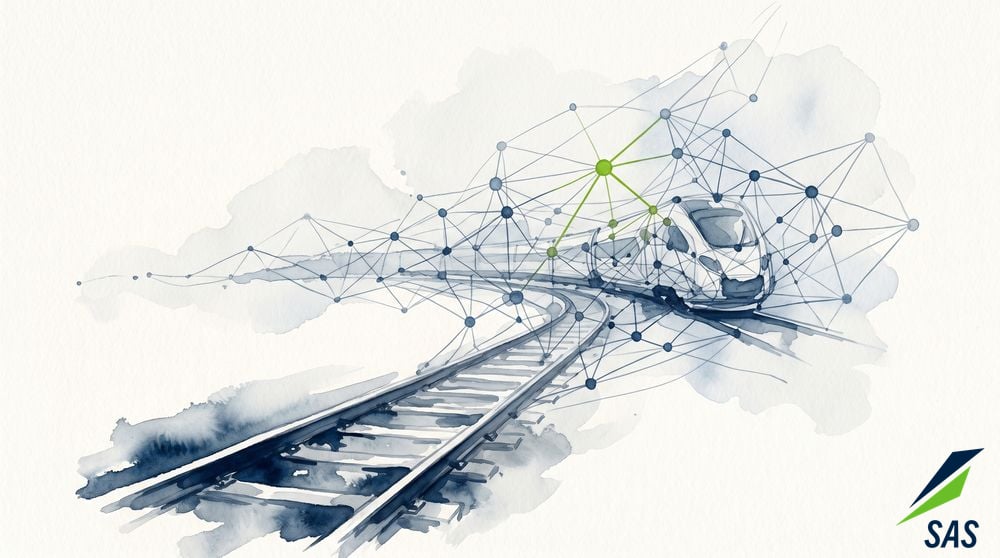
Edge AI for Assets: Why Your Critical Infrastructure Can't Wait for the Cloud
Real-time maintenance decisions for hospitals, water networks, and transport - without cloud dependency or latency risks.
.jpg)
Here's a scenario that plays out more often than it should: a hospital's HVAC system shows early signs of compressor failure. The vibration signature is textbook. The AI model knows exactly what's happening. But the diagnosis sits in a cloud queue for 47 seconds while the system waits for a response. In a server room, 47 seconds is nothing. In an operating theatre where temperature stability matters, it's a different story entirely.
This isn't an argument against cloud computing. Cloud infrastructure has transformed what's possible in asset management. But for certain assets in certain contexts, the assumption that everything should route through a distant data centre deserves scrutiny.
The latency problem is real, but it's not the whole story
When people talk about edge AI, latency usually comes up first. And yes, the physics matter. Light travels through fibre at about 200,000 kilometres per second, which sounds fast until you realise that a round trip to a cloud data centre in another state adds 20-50 milliseconds minimum. For a pump that's about to seize, those milliseconds compound.
But latency is actually the easy problem to explain. The harder challenges are more subtle.
Connectivity isn't guaranteed. Water treatment plants in regional areas, underground mining operations, remote substations - these assets don't always have reliable network access. When your AI depends on cloud connectivity and the network drops, you're back to manual inspection or, worse, flying blind.
Bandwidth costs scale awkwardly. Modern condition monitoring generates enormous data volumes. A single vibration sensor sampling at 25.6 kHz produces roughly 2GB per day. Multiply that across hundreds of sensors and the economics of shipping everything to the cloud start to look questionable. Edge processing lets you analyse locally and send only the insights.
Data sovereignty isn't optional for everyone. Hospitals can't send patient-adjacent operational data offshore. Defence contractors face strict requirements about where data lives. Water utilities increasingly face questions about foreign access to critical infrastructure data. Edge AI keeps sensitive operational intelligence where it belongs.
What 'edge' actually means in practice
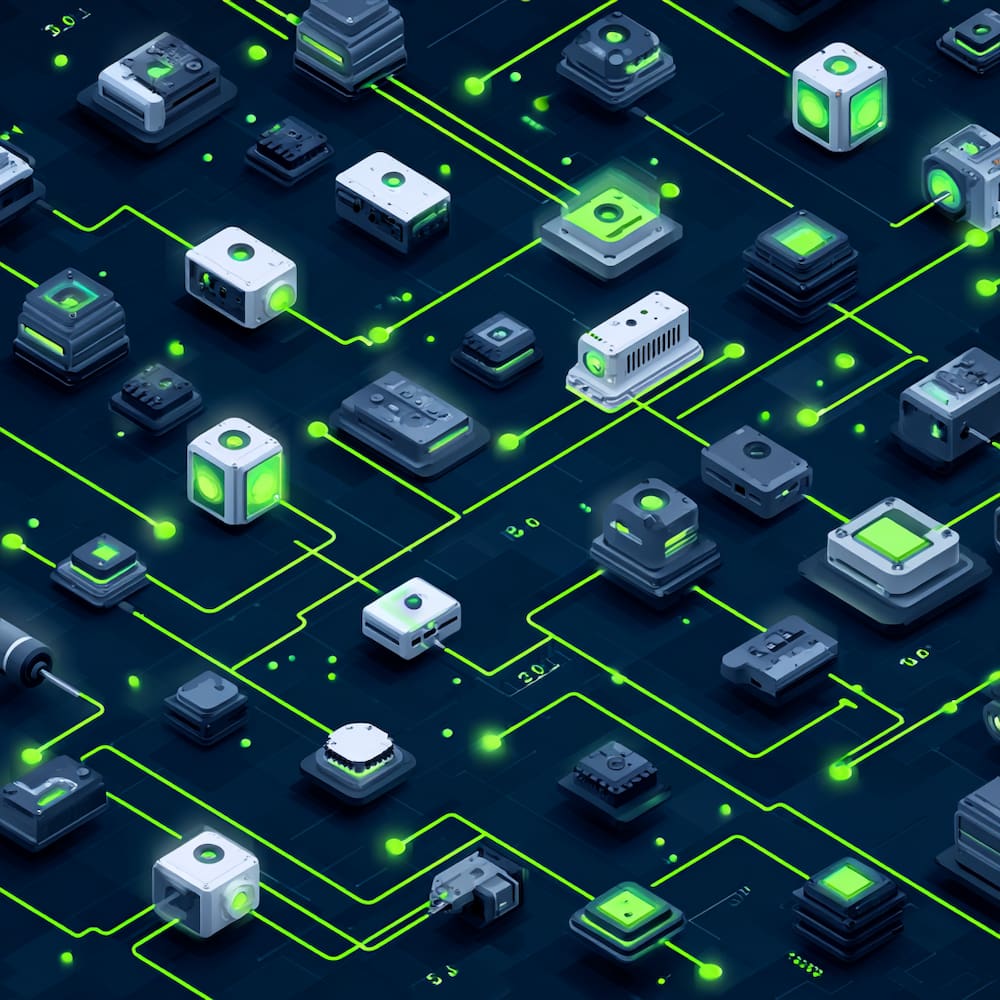
The term gets thrown around loosely, so let's be specific. Edge AI for asset management typically means running inference - the part where a trained model makes predictions - on hardware that sits physically close to the assets being monitored. This could be an industrial PC in a control room, a gateway device in a substation, or purpose-built hardware mounted on the asset itself.
The model training usually still happens elsewhere, often in the cloud where computational resources are abundant. But the operational decisions happen locally, in real time, without depending on external connectivity.
This distinction matters because it shapes what's actually achievable. You're not trying to replicate a data centre at the edge. You're deploying lightweight, purpose-built models that do specific jobs well.
Where edge AI makes the strongest case
Not every asset needs edge intelligence. A fleet of office air conditioners probably works fine with cloud-based analytics and next-day maintenance responses. But several categories of assets make a compelling case for edge deployment.
Safety-critical systems where response time directly affects outcomes. Hospital infrastructure, rail signalling systems, emergency power generation. These assets need decisions in milliseconds, not seconds.
Remote or mobile assets with intermittent connectivity. Mining equipment, agricultural machinery, distributed renewable energy installations, regional water infrastructure. If you can't guarantee network access, you need local intelligence.
High-frequency monitoring where data volumes make cloud transmission impractical. Rotating machinery with vibration sensors, electrical systems with power quality monitors, anything generating continuous high-resolution data streams.
Regulated environments where data residency requirements constrain architectural choices. Healthcare, defence, critical infrastructure, government assets.
The honest trade-offs
Edge deployment isn't free. The hardware costs more upfront than a cloud subscription. The models need to be smaller and more efficient, which sometimes means accepting slightly lower accuracy. Updating models across distributed edge devices is more complex than pushing a new version to a centralised cloud service.
And there's a skills question. Organisations need people who understand both operational technology and machine learning - a combination that's still relatively rare.
The right answer for most organisations isn't pure edge or pure cloud. It's a considered hybrid where edge handles time-critical decisions and cloud provides the heavy lifting for model training, long-term analytics, and cross-site pattern recognition.
Getting started without overcommitting
If edge AI sounds relevant to your context, the practical starting point is usually a pilot on a contained set of critical assets. Pick something where the business case is clear - high consequence of failure, unreliable connectivity, or genuine latency sensitivity.
Start with proven use cases like vibration-based fault detection for rotating machinery or thermal anomaly detection for electrical infrastructure. These are well-understood problems where edge deployment has a solid track record.
And be realistic about the timeline. A meaningful pilot typically takes three to six months to generate enough operational data to validate the approach. The goal isn't to prove edge AI works in general - it does. The goal is to prove it works for your specific assets, in your specific context, with your specific constraints.
The assets that keep hospitals running, water flowing, and trains moving deserve intelligence that doesn't depend on a network connection to a data centre hundreds of kilometres away. For critical infrastructure, edge AI isn't a nice-to-have. It's increasingly becoming the baseline expectation.
Where Edge AI Fits in the Bigger Picture
Edge deployment is one piece of a broader transformation happening across asset management. The convergence of AI, machine learning, and real-time analytics is reshaping how organisations approach maintenance and reliability decisions. For context on the wider trends driving this shift, our analysis of why 2026 marks a turning point for AI in asset management explores the organisational and technological factors accelerating adoption.
The market trajectory supports the urgency. According to Grand View Research's edge computing market analysis, the sector is growing at 33% annually, with Industrial IoT applications leading adoption. For asset-intensive organisations, the question is increasingly not whether to deploy edge intelligence, but how quickly they can get there.
ISO 55001 Certification Is a Floor, Not a Finish Line