Australian mining fleets: what the data actually shows
Five findings on Australian mining fleet reliability, drawn from ABS statistics, peer reviewed measurement and the patent register. Free 63 page whitepaper, 118 references.
.jpg)
Australian mining fleets are getting less reliable, and the industry cannot tell you what that costs. We spent several weeks trying to source the figures the mining sector uses to justify predictive maintenance on haul truck and excavator fleets. Most of them do not survive contact with their own footnotes. So we built a replacement out of official statistics, peer reviewed measurement and arithmetic a reader can check.
Five findings from the paper.
1. Mining productivity has fallen five years running
Mining multifactor productivity fell for a fifth consecutive year in 2024 to 2025, the largest fall of any of the sixteen market sector industries. The Australian Bureau of Statistics attributes it in part to production lost to maintenance activity, and to a 5.6 per cent rise in hours worked restoring capacity after unplanned maintenance.
That is a government statistical agency saying unplanned maintenance is dragging on national productivity. It is a better foundation for a fleet business case than any vendor percentage.
2. The savings figures everyone quotes have no source
A ten times return, a 25 to 30 per cent cut in maintenance cost, 70 to 75 per cent of breakdowns eliminated.
Those figures trace to one uncited paragraph in a United States government facilities guide, unchanged since at least 2004, introduced by the phrase “independent surveys indicate” and attributed to nobody.
They are still circulating. A 2026 research report written for Australian and New Zealand practitioners restates two of them to the percentage point. The paper traces the whole chain.
3. One machine cannot learn from itself
An Australian study instrumented a single production excavator for nine months: 58 sensors and 45 million rows of data, which yielded 21 labelled failure events, with 57 per cent of timestamps missing at least one value.
More sensors on that machine would have produced more rows and not one more failure to learn from. The binding constraint on fleet analytics is observed failures, not instrumentation. That single finding decides the architecture, and it is why buying more sensors is usually the wrong first move.
4. Nobody has deployed the obvious answer
Federated learning lets a whole fleet learn from every machine's failures without the raw data leaving your servers. We checked whether anyone in mining is using it, three ways.
A full text patent search across the major equipment manufacturers returns a single document, and it is about railway track defects. The scholarly literature returns zero works combining federated learning with mining equipment. A 2026 survey of Australian and New Zealand practitioners calls adoption embryonic, in a market where nearly forty five per cent have deployed no artificial intelligence at all.
The paper explains why that gap exists, and it is not because the manufacturers failed to think of it.
5. The prize is calculable without anyone's percentage
On a 220 truck Australian fleet, one percentage point of physical availability is worth roughly 8.6 million tonnes of additional material movement a year, or about 2.6 haul trucks you do not have to buy. Every input is operator disclosed and the full arithmetic is in Part 6, laid out so you can substitute your own numbers.
What we deliberately do not publish
No dollar per hour cost of haul truck downtime, because every circulating figure traces to content aggregation sites. No ultra class tyre prices, because no manufacturer publishes them. No claim that maintenance is 30 to 50 per cent of a mine's budget, because we traced it to a vendor blog post that was cited into two peer reviewed journals.
Each omission is named in the paper so you can recognise the figure when someone quotes it at you.
Get the whitepaper
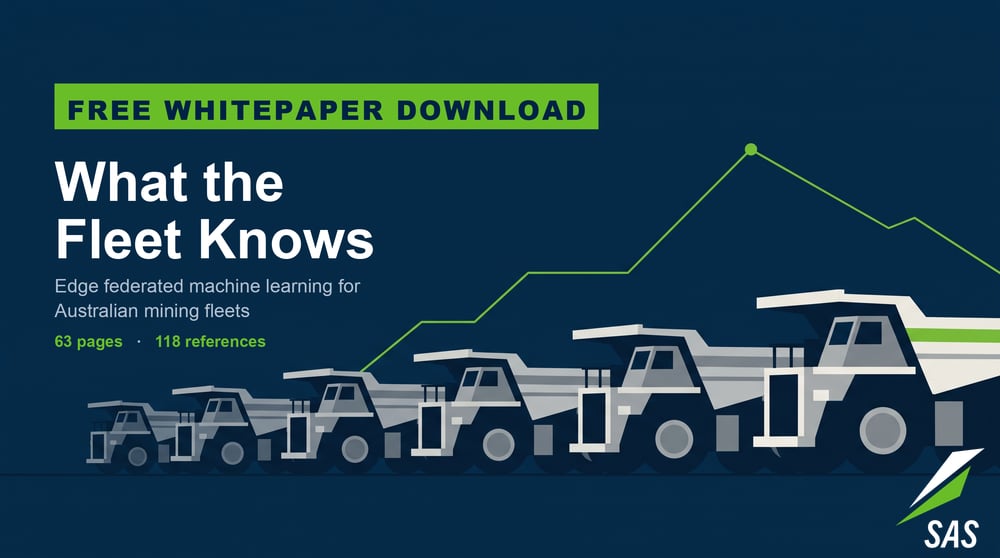
What the Fleet Knows is 63 pages with 118 numbered references. Every quantitative claim carries a source, a date and an evidence class, and where a claim rests on a secondary summary the paper says so on the page. It includes the reliability forecast for a haul truck over six months, what the telematics terms of use actually say about your machine data, and a staged path in which nobody builds a model until the data is shown capable of carrying one.
It is written to be checked rather than believed. If you find an error in it, we would genuinely like to know.
Australian mining fleets: what the data actually shows