Under Harbour Tunnel FMECA & Condition Assessment | SMEC Australia & BHP
We provide expert asset management consulting services to help you optimise your operations.
.jpg)
Overview
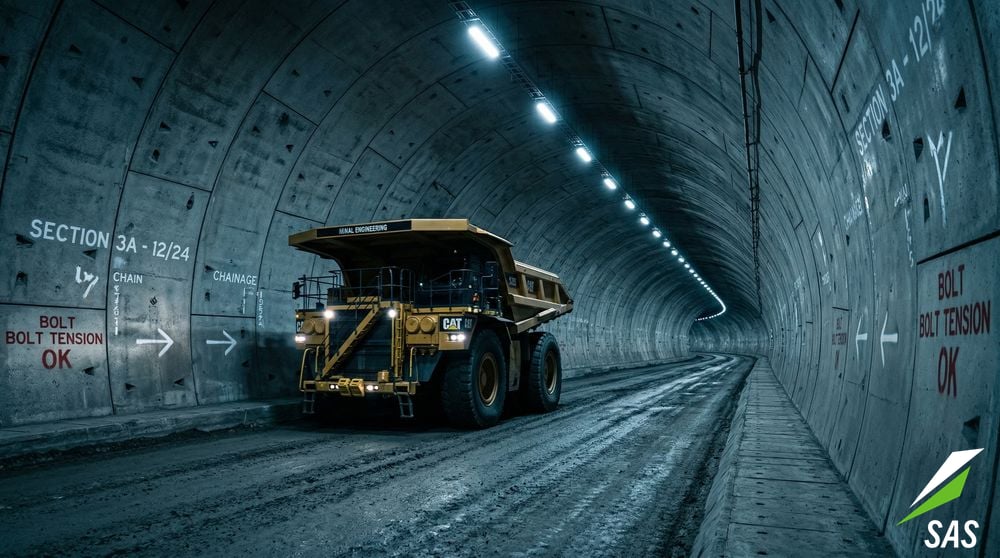
SMEC Australia engaged SAS Asset Management to provide specialist FMECA and condition assessment support for BHP's Under Harbour Tunnel (UHT) at Port Hedland in the Pilbara region of Western Australia. The UHT is a bored tunnel running under the harbour, forming critical infrastructure within BHP's iron ore port operations.
BHP's internal asset management and inspection team (AIMS) had accumulated a substantial defect inspection dataset from routine tunnel surveillance. However, this field data had not been systematically linked to the tunnel's existing FMECA, meaning severity ratings were based on engineering judgement rather than actual observed condition. SMEC partnered with SAS-AM to bridge this gap — connecting real-world defect data to structured failure analysis to produce condition-based severity ratings grounded in evidence.
The Challenge
The UHT's civil infrastructure — including tunnel linings, ground support systems, drainage, walkway supports, and cathodic protection systems — operates in a harsh marine environment subject to corrosion, ground movement, and heavy operational loading. BHP's inspection programme had generated over 2,250 individual defect records across the tunnel corridor, covering components ranging from concrete segments and rock bolts to drainage channels and ventilation ducting.
The challenge was twofold. First, the defect data used different component naming conventions and failure descriptions than the existing 54-row FMECA, making direct mapping complex. Second, the previous FMECA severity ratings reflected design-stage engineering judgement rather than actual observed condition — meaning maintenance priorities may not have reflected the true risk profile of the tunnel infrastructure.
Our Approach
Defect-to-FMECA Mapping
SAS-AM developed a structured mapping methodology to link the 2,250 field defects to the 54 FMECA items. This involved reconciling component taxonomies between the inspection dataset and the FMECA register, mapping defect failure mechanisms to FMECA failure modes, and establishing clear traceability between field observations and analytical severity assessments. Where defect components could not be directly mapped (68 defects across categories including walkway supports and cathodic protection), these were flagged for FMECA expansion in future assessment cycles.
Condition-Based Severity Update
Using the mapped defect data, SAS-AM updated the FMECA severity ratings to reflect actual observed condition rather than theoretical estimates. We applied a maximum severity aggregation method — where multiple defects mapped to a single FMECA row, the highest observed severity was adopted. This approach updated 32 of the 54 FMECA rows with evidence-based severity ratings for both safety and financial consequence dimensions, while 22 rows with no matching defects retained their original engineering judgement ratings.
Deliverables
SAS-AM delivered an updated FMECA register with condition-based severity ratings and a full audit trail linking each severity update to its source defect data. An interactive visualisation was also produced to help SMEC and BHP's AIMS team explore the defect-to-FMECA relationships and understand where the highest-severity failure modes were concentrated within the tunnel corridor.
Results
- 2,250 defects mapped to 54 FMECA items using a structured, repeatable methodology
- 32 FMECA rows updated with condition-based severity ratings grounded in actual inspection data
- Safety and financial severity dimensions independently assessed and updated from field evidence
- Full audit trail connecting every severity update to its source defect records
- 68 unmapped defects identified for FMECA register expansion in future cycles
Why This Engagement Matters
Critical underground infrastructure like the BHP Under Harbour Tunnel requires maintenance and renewal decisions grounded in actual condition data, not theoretical assumptions. By systematically linking field defect records to structured failure analysis, SAS-AM enabled SMEC and BHP to transition from judgement-based to evidence-based severity ratings — ensuring maintenance investment is directed where the tunnel's real risk profile demands it. This approach provides a repeatable framework that can be applied to future inspection cycles, building a longitudinal view of tunnel condition that supports long-term infrastructure stewardship.
Where theory meets execution
See how we’ve applied our ideas to generate generational changes within our comunity.
Automated Annual Works Planning from Maximo | Yarra Trams