
Automated Annual Works Planning from Maximo | Yarra Trams
We provide expert asset management consulting services to help you optimise your operations.
.jpg)
Overview
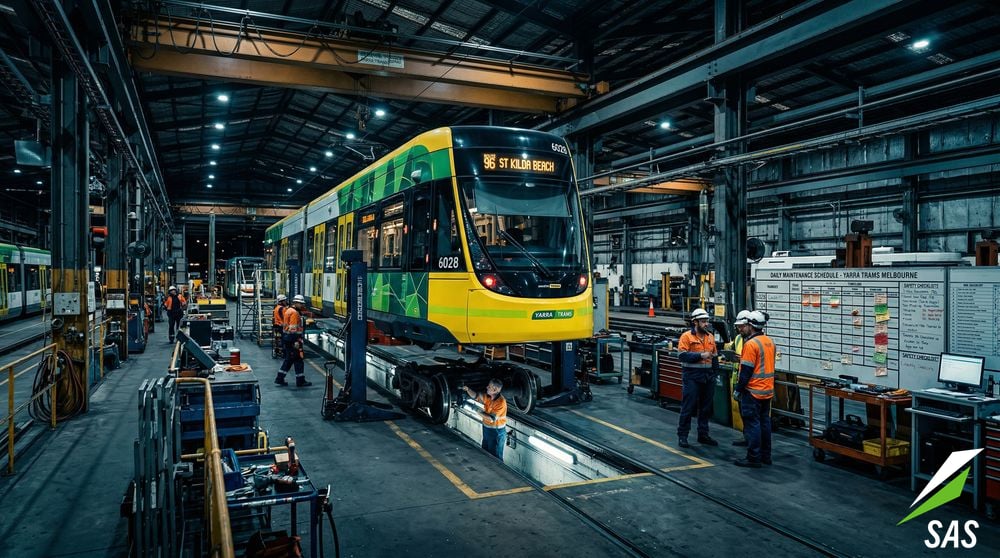
Yarra Trams operates one of the world’s largest tram networks, maintaining hundreds of vehicles across Melbourne’s extensive public transport network. Their preventive maintenance regime is managed through IBM Maximo, with a complex web of PM rules governing time-based, distance-based, and hours-based maintenance intervals across the fleet.
SAS Asset Management was engaged to automate the annual works planning process — replacing a labour-intensive manual workflow with a tool that programmatically translates Maximo PM rule data into a rolling three-year forward maintenance forecast.
The Challenge
Yarra Trams’ annual works planning process required translating hundreds of Maximo PM rules into a time-phased forecast predicting when every maintenance task would fall due for every asset across the fleet. Previously, this involved manually extracting data from Maximo, cross-referencing PM rules against asset registers in spreadsheets, and building forecast models cell by cell.
The process consumed four to six weeks of senior planner time annually and suffered from version control issues, transcription errors, and incomplete rule-asset coverage. Leadership had limited visibility into the forward maintenance workload, making it difficult to identify resource bottlenecks or optimise scheduling across the fleet.
Our Approach
Data Architecture Mapping
We began by mapping the three data streams that needed to connect: PM rule definitions (task descriptions, intervals, trigger types, applicable asset classes), the asset register (which specific trams, bogies, and components each rule applies to), and operational data (current meter readings, last completion dates, and compliance deadlines).
Automated Forecast Engine
SAS-AM developed an automated tool that ingests Maximo PM rule exports, joins them against the asset register and operational meter data, and generates a complete three-year forward forecast. The engine parses Maximo’s PM rule structure to extract interval logic and trigger hierarchies, matches rules to assets based on classification and applicability criteria, calculates next-due dates from last-completion data and meter readings, and distributes forecast work orders across planning periods with resource levelling.
Planning Integration
The output feeds directly into Yarra Trams’ existing planning workflows as a structured dataset, replacing the manual spreadsheet process entirely. Planners can regenerate forecasts on demand whenever PM rules change or new assets enter service.
Results
- Planning cycle reduced from 4–6 weeks to hours — complete fleet-wide forecasts generated on demand
- Improved forecast accuracy — automated process eliminates transcription errors and ensures complete rule-asset coverage
- Three-year forward visibility — leadership can identify demand peaks, resource bottlenecks, and scheduling optimisation opportunities
- Repeatable on demand — forecasts regenerated whenever PM rules change or new assets enter service, not just annually
Why This Engagement Matters
The data needed for better maintenance planning often already exists within CMMS systems. The barrier is not missing data — it’s the absence of an analytical layer that connects disparate datasets and translates them into decision-ready outputs. For Yarra Trams, the raw material was always in Maximo. SAS-AM built the bridge between rule data and forward planning, unlocking a genuine planning asset without requiring a new system or major technology investment.
Where theory meets execution
See how we’ve applied our ideas to generate generational changes within our comunity.

Asset Management Software Requirements and Market Evaluation for Westernport Water
