AI Futures Day: How a Critical Infrastructure Operator Chose Where AI Should Start
We provide expert asset management consulting services to help you optimise your operations.
.jpg)
Executive Summary
An operator of a nationally significant critical infrastructure asset in the water sector wanted to set the direction for a multi year AI investment plan. The leadership team was hearing plenty about AI. What it did not have was an agreed, defensible view of where AI should start in its own operation.
SAS-AM designed and facilitated a one day AI Futures Day on site. Rather than presenting a vendor view of the future, the day was built so the people who run the asset generated, sorted, scored and ranked the opportunities themselves, using online questionnaires on their own phones before the day and throughout it. By the close, the room had a ranked top three, an owner and a date against each, and a working prototype of its first choice, built live in twenty minutes.
The Challenge
Most AI conversations in asset intensive operations start in the wrong place. They start with the tool, then go looking for a problem it can solve.
For a critical infrastructure operator, the stakes are higher. Security obligations shape what data can go where. Probity shapes how advisers engage. And a leadership team under pressure to show progress on efficiency can easily be pushed toward the loudest idea in the room rather than the most valuable one.
The operator needed three things from the day:
- A view of where AI could genuinely help, grounded in how work is planned, scheduled and run today
- A way to judge each idea on value for money, not enthusiasm
- A decision, with ownership, rather than another list
The Approach
SAS-AM ran the day on four design rules, each chosen to protect the quality of the decision.
1. Write before you talk. Every contribution started privately, on each person's own phone, before any discussion. This stops the most senior voice from anchoring everyone else.
2. People diverge first. No AI generated material entered the room until participants had produced their own. The morning began with a simple prompt, describe a bad day at the plant in specifics, then moved to a silent inventory of pain points, typed on phones and shown verbatim on the screen one card at a time.
3. Plot every individual dot. When opportunities were scored for value and effort, every person's score was shown, never just the average. The conversation then went to where the room disagreed most, which is where the useful information sits.
4. Structure substitutes for trust. As a new adviser, SAS-AM had not yet earned the room's trust, so the structure carried it: private scoring, anonymous reveals, and clear rules about what would and would not be discussed.
Phones as the Pen: Online Mobile Questionnaires
The evidence for the day was gathered and captured through online mobile questionnaires, built and hosted by SAS-AM. Nothing to install, nothing to print, and it worked on any phone.
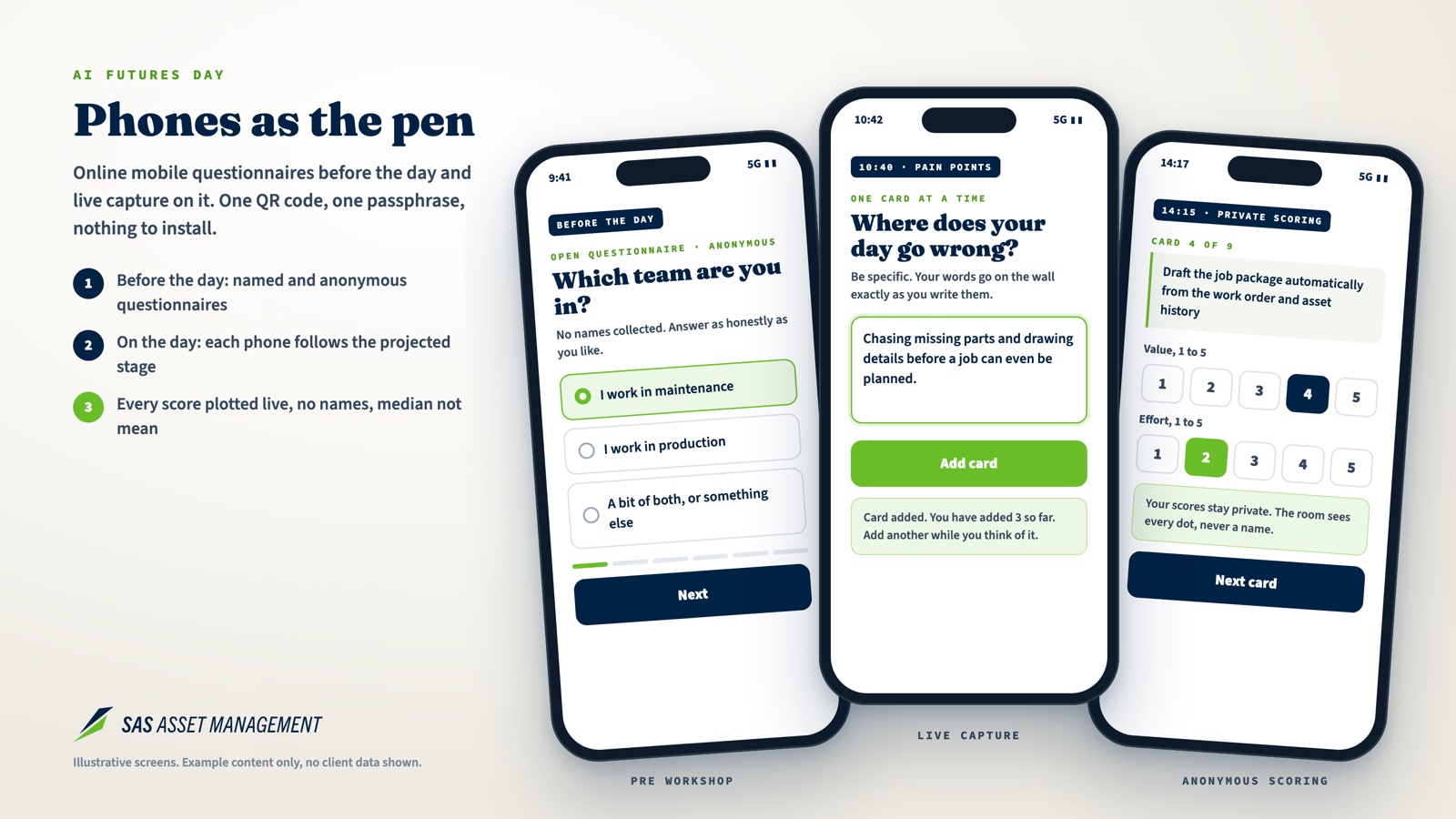
Before the day, two questionnaires. A named set went to the leadership attendees, with questions tailored to what each person owns. A second, anonymous set was open to anyone in production and maintenance, forwarded internally by the client's champion. It asked only which team the respondent worked in and collected no names at all, so people could be candid. Each set had its own passphrase, checked on the server, so the open set could be shared widely without anyone being able to answer as a named leader.
On the day, one QR code and one passphrase. Every participant's phone became their input device. As the facilitator advanced the projected deck, each phone switched automatically to the matching activity: adding pain point cards, building on someone else's idea, completing candidate cards, annotating during the gallery walk, scoring value and effort, ranking the top three and writing premortem lines. Nobody scanned twice.
Live, anonymous and honest. Scores appeared on the screen as they landed, every individual dot, never a name, and always summarised as a median rather than a mean. When it came time to decide, the leadership team's scores were shown beside the wider workforce's questionnaire answers, so the room could see exactly where its view matched the people doing the work, and where it did not.
A record, not a photo of a whiteboard. Because every card, score and comment was captured digitally, the record of the day was produced straight from the room's own entries, ready to share before anyone left.
How the Day Ran
The day itself moved through five stages:
- Frame and contract. A clear declaration up front of exactly which tools would be used on the day and where data would and would not go, so the governance question was answered before it was asked.
- Surface the work. Participants grouped their own pain point cards into themes. Facilitators kept their hands off, so the taxonomy was the room's, not ours.
- Generate candidates. Small groups built candidate AI applications on a common template, then a silent gallery walk let everyone annotate every idea.
- Score and rank. An estimate, talk, estimate round produced value and effort scores the room could defend. The scores were plotted live from the phones, compared with the workforce questionnaire, and forced into a top three with no ties allowed.
- Build and commit. SAS-AM built a working prototype of the room's number one choice in a twenty minute hard stop, followed by a short premortem on the top three. The senior leader then named an owner and a date against each.
The Outcomes
- A ranked top three, owned and dated. The day closed on a decision, not a backlog. Each priority left the room with a named owner and a first date.
- A prototype in the room. The number one choice was built live, on the day, which turned an abstract idea into something the team could see, question and test.
- A defensible basis for investment. Because every individual score was visible and the widest disagreements were discussed openly, the ranking could stand up to scrutiny from the people who will fund it.
- A voice for the wider workforce. The anonymous questionnaire brought the views of people who were not in the room into the decision, alongside leadership's.
- A written direction within days. The workshop output was consolidated into a concept and feasibility view of the nominated applications, judged on value for money, to sequence the multi year AI investment plan.
"Impressed with SAS initial engagement on AI journey and interested to see it translate into some tangible business benefits and improvements."
Client feedback, AI Futures Day
What We Learned
- Start with the work, not the technology. The strongest candidates came from the pain point cards, not from any list of AI capabilities.
- Governance belongs at the start. Declaring the tools and the data boundaries first removed the biggest source of hesitation for a critical infrastructure team.
- Disagreement is data. Showing every score, and discussing only the widest spreads, produced a better ranking in less time than open debate.
- Phones beat sticky notes. Online mobile questionnaires made private input, anonymous scoring and a live view of the whole room practical, and left a complete digital record.
- A prototype changes the conversation. Twenty minutes of live build did more to make AI feel practical than any amount of slides.
Ready to Find Where AI Should Start for You?
SAS-AM runs AI Futures Days for asset intensive organisations that want a clear, defensible starting point for AI investment. Start with our AI readiness check, or contact us to talk through a day built around your operation.
Project details: Water · Critical infrastructure · One day facilitated workshop · Online mobile questionnaires before and during the day · Written direction.
Where theory meets execution
See how we’ve applied our ideas to generate generational changes within our comunity.
12,000 Assets, One Standard | GeelongPort