
MaximoLive 2026 Debrief
The room's survey results, the demos, the videos and the slides from our MaximoLive 2026 talk, Augment Maintenance with AI Agents.

On Thursday 15 October 2026, in Conference Hall 2 at Crown Melbourne, SAS-AM presented Augment Maintenance with AI Agents at MaximoLive 2026. 49 people answered the live pulse survey during the session. This debrief collects everything from the talk in one place: the room's results, the demos, the walkthrough videos, the slides and the tools.
The session abstract opened with a claim: planners and schedulers will be redundant in two years. Our answer on the day was half right. The tasks go. The judgement stays.
What the room told us
Every answer was anonymous, and the charts below show the final tally from all 49 responses.
- Most organisations are early. 49% are just exploring AI in maintenance and 22% have not started. Only 4% have it in production use.
- Few people trust their failure codes. 18% trust them mostly or completely. 24% do not trust them at all, and another 18% do not use them.
- Data quality is the first barrier. 63% put it in their top three concerns, ahead of trust in the outputs (55%) and IT and cyber approval (45%).
- The first job to hand over is chasing missing data. The room ranked it ahead of triaging new work orders and failure coding.
Where is your organisation with AI in maintenance today?
How much do you trust the failure codes in your Maximo?
What stops you handing it over? Share of people naming each in their top three
Buy the planning week back
Most of the room takes between half a day and two days to build one week of maintenance work. 55% said a quarter to three quarters of a planner's week goes on assembling paperwork rather than judgement.
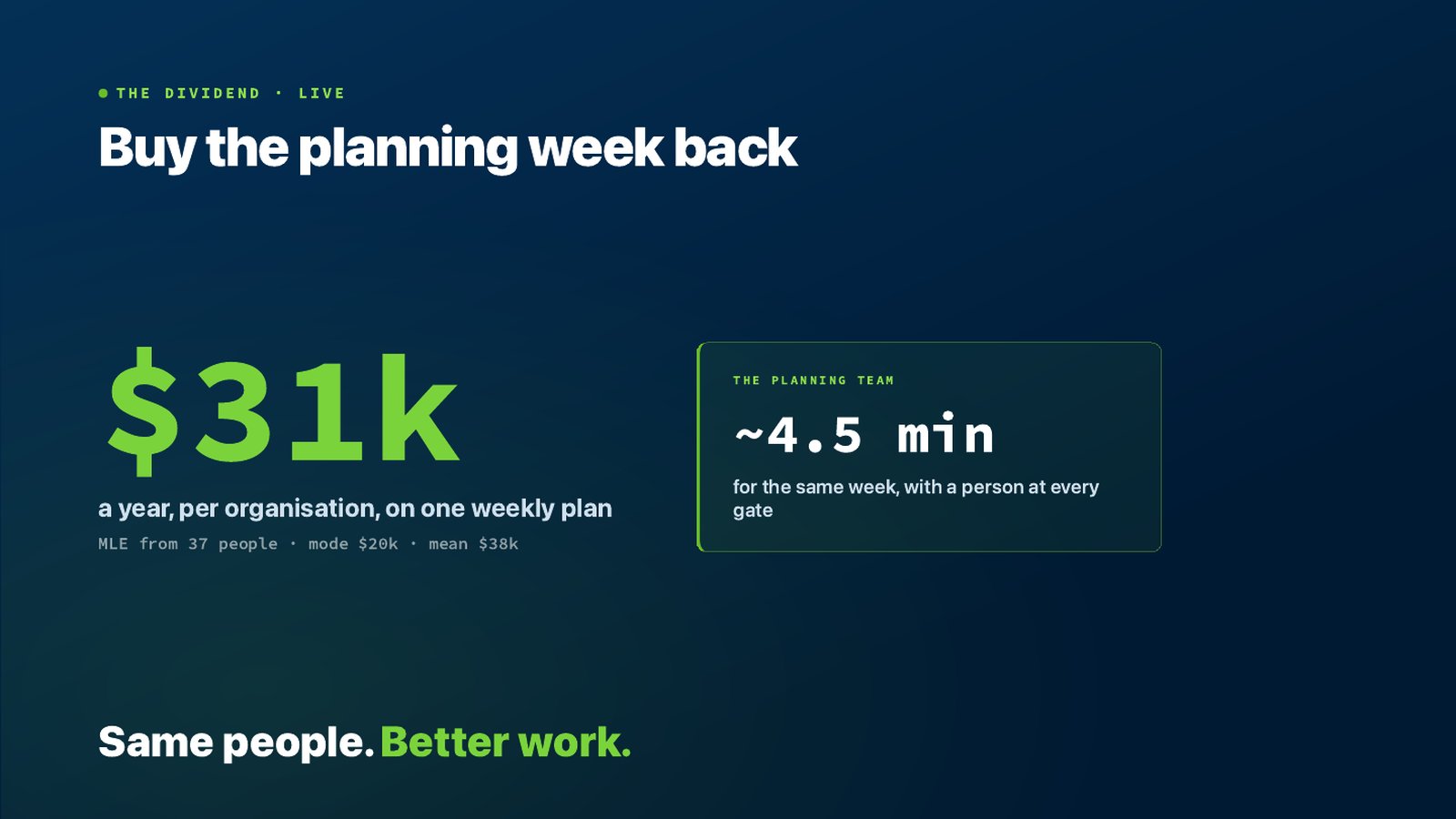
We paired each person's planning time with what a planner costs their organisation. The room's median annual cost of building one weekly plan came to about A$31,000 per organisation, from 37 people who answered both questions. That figure is the median of a lognormal distribution fitted to their answers by maximum likelihood.
In Demo 2, six AI agents planned the same kind of week in about four and a half minutes, with a person approving at every gate. Each agent has one job: Coordinator, Data Quality, Reliability Engineer, Planner, Scheduler and Supervisor. The planners stay. Their hours move from assembling packages to the decisions only a planner can make.
An agent inside its harness
Anthropic, OpenAI and Google describe agents in different words with one common thread: the model decides the next step. A chatbot answers you, a prediction warns you, and an agent acts for you.
Every agent we build sits inside a harness of a system prompt, skills, tools, memory and an audit log. One rule governs all of it: the agent's write permission ends at WAPPR. It can read every record it needs. It can only write a work order in waiting approval status, and a person approves it. Around that rule sit zero trust, where every input and output is verified, and least privilege, where the agent holds only the access the job needs.
Agents are assets too. They follow the same lifecycle as any other asset, from a business case and an owner before any tool is chosen, through design, build, handover, operation and maintenance, where condition means accuracy and drift.
Demo 1: free text in, failure codes out
The first demo classified work order free text against an FMEA failure mode taxonomy: one decision per work order, 1,000 work orders per batch. The model returns structured JSON. Every failure mode ID is checked against the taxonomy and never invented, and gaps are flagged rather than forced. Results of 85% confidence and over are accepted, 50 to 84% go to a person, and anything below 50% goes to an engineer.
What it takes is less than most people expect:
Three questions decide what is ready
Three questions sort any maintenance task. Is the input trustworthy? Can you undo it? Is being wrong cheap? A task that passes all three is ready for an agent today.
- Ready today: triaging new work orders, failure coding and chasing missing data.
- Human in the loop: building work packages, the weekly schedule and inspection report drafts.
- Not yet: approving work, changing PM frequencies and retiring assets.
Maximo's native AI works inside one record. Agents work across records and systems. Switch on what Maximo already does first, then put agents beside it.
The AI readiness check scores your organisation on eight questions in about three minutes. It asks for no details and is scored by code, so the same answers always give the same result.
Real work, measured
Source: SAS-AM project records, with clients anonymised by agreement.
The talk and the tools
The full talk walkthrough runs through every slide in three minutes. The survey charts in it show sample answers; the real results are above.
The maintenance strategy selector applies RCM decision logic one failure mode at a time.
The slides
Download the full deck as a PDF, including the room's final results and the planning dividend.
Augment Maintenance with AI Agents: the deck
Fill in your details to download the MaximoLive 2026 slides as a PDF.
You're all set!
Your download is ready. Click below to get the slides from the talk.
Download the DeckYour turn
Name three workflows and score each one against the three questions. Start with the one that passes all three. Take the readiness check, meet the AI team, or reply to the email that brought you here and we will work through your three with you.